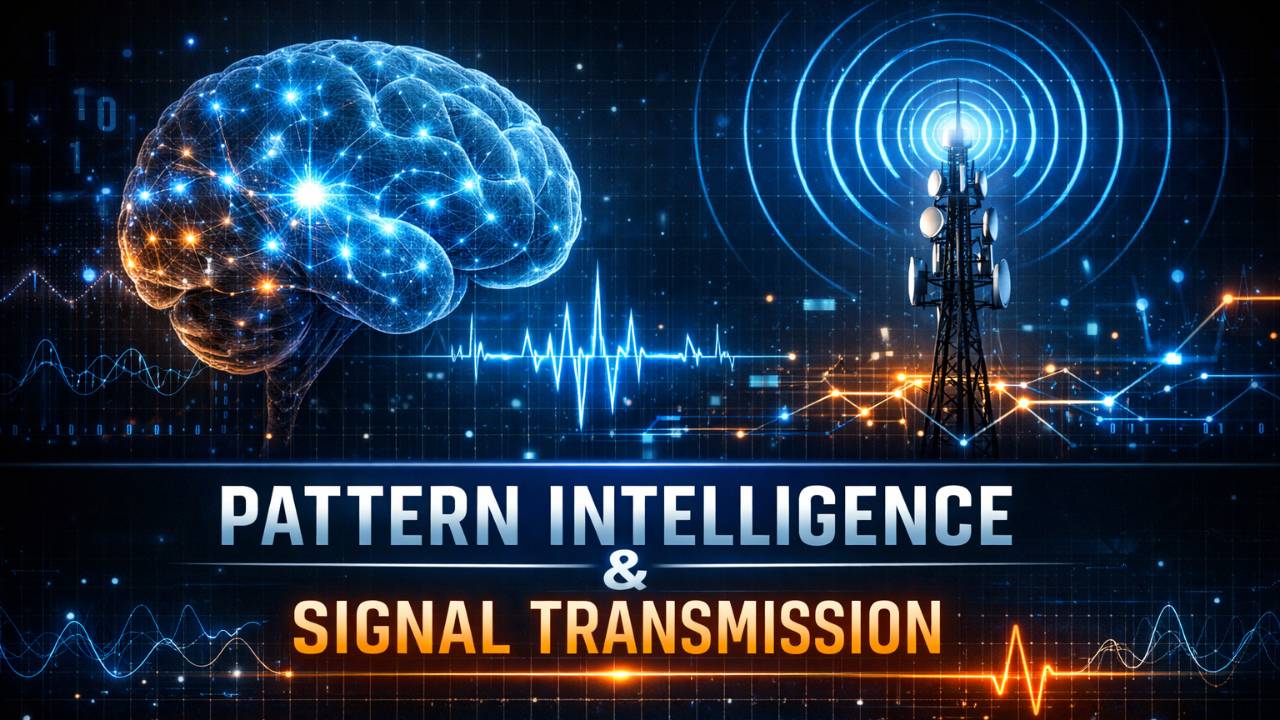
Resonance, Perception, and Signal Transmission
Electromagnetic and Cognitive Frameworks for Human Communication Systems
Most people treat “signals” as either physics or psychology.
This course shows you how they actually connect.
Resonance, Perception, and Signal Transmission gives you a structured, interdisciplinary framework for understanding how signals move through physical systems, biological cognition, and communication networks—without drifting into mysticism, vague “frequency” claims, or reductionism.
Instead of asking whether something is “real” or “just psychological,” you’ll learn to track:
What is the signal, what is the channel, what is the noise, and where interpretation enters the system.
What You’ll Learn
- How resonance, frequency, and wave behavior work as real mechanisms
- How perception is shaped by neural encoding, prediction, and emotional bias
- The fundamentals of communication systems: signal, channel, noise, feedback
- How messages distort and evolve through transmission and networks
- The role of ritual, symbols, and narratives in anchoring meaning
- How to map signal → interpretation → behavior → retransmission
- How collective dynamics (groups, media, networks) influence meaning without “control” narratives
What’s Included
Your enrollment includes:
- • 6 concise modules (each under 60 minutes)
• Video lessons and short readings
• Worksheets and practical exercises
• Optional quizzes for reinforcement
• Optional capstone integration map
• Ethical use and AI-boundaries guidelines
Everything is designed for clarity and practical application, not academic overload.
Who This Course Is For
This course is designed for people whose work involves interpreting information and guiding others through complexity:
-
Advanced learners who want a rigorous, cross-domain model of communication
-
Educators, researchers, and systems thinkers working with complexity
-
Analysts and practitioners needing clarity on signal vs noise
-
Anyone who wants to understand “frequency” and resonance without hype
