
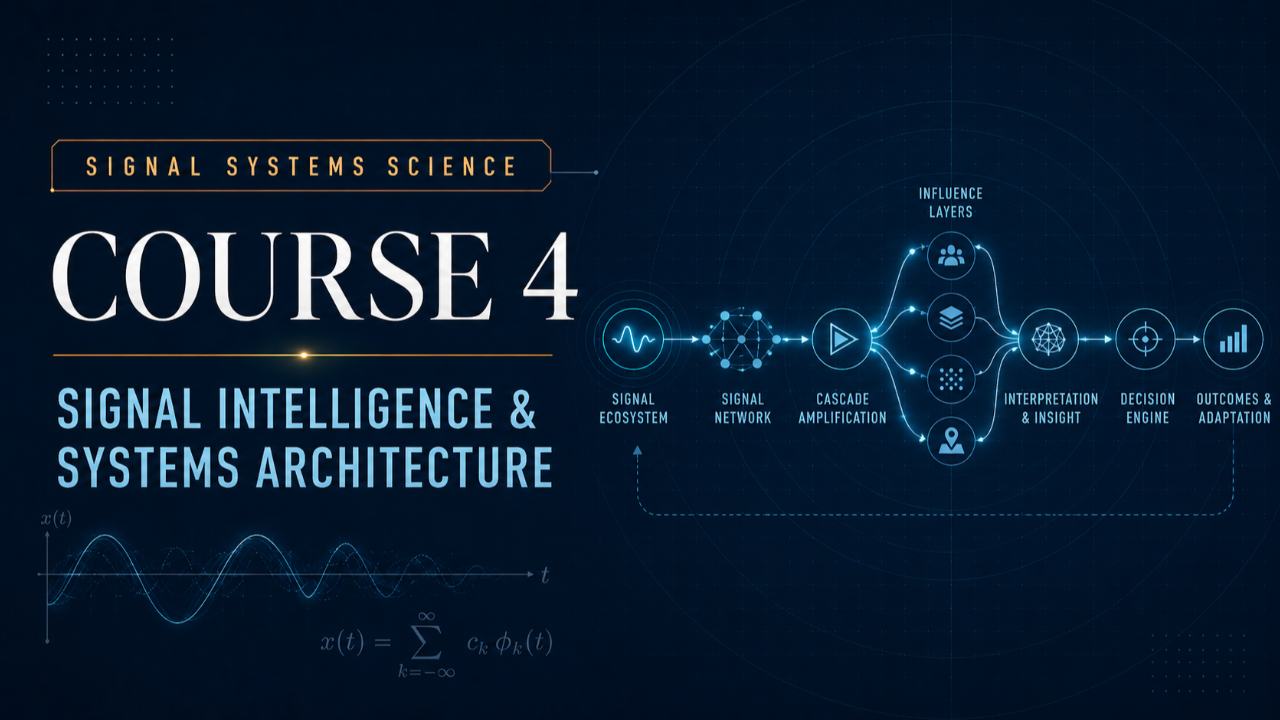
Course 4: Signal Intelligence & Systems Architecture
Learn How Signals Become System-Level Outcomes
Understand how signals move through ecosystems, spread through cascades, gain amplification, shape interpretation, and become decisions.
Course 4 brings together the major layers of the Signal Systems pathway. You will learn how signals operate inside larger systems, how cascades expand or collapse, how influence networks shape visibility, and how interpreted signals become decisions and outcomes.
The core model for this course is:
Signals → Networks → Cascades → Amplification → Influence → Interpretation → Decisions → Outcomes
What You’ll Receive
Full Course 4 Access
Complete the lessons at your own pace and build a clear understanding of signal intelligence and systems architecture.
Course 4 Workbook
Use guided exercises to map signal ecosystems, cascades, amplification points, influence networks, and decision pathways.
Diagram Pack
Review visual models for signal flow, cascade dynamics, amplification layers, and decision architecture.
Module Quizzes
Check your understanding and reinforce the key concepts from each module.
Final Integration Assignment
Apply the full Course 4 framework to one real-world signal system from origin to outcome.
Inside the Course
Module 1: Signal Ecosystems
Learn how signals operate inside interconnected environments made of sources, nodes, receivers, amplifiers, responses, and feedback loops.
Module 2: Signal Cascades
Learn how signals spread through repeated transmission, expand through networks, encounter interference, and lose momentum.
Module 3: Amplification & Influence Networks
Learn how hubs, power nodes, amplification layers, and influence structures shape visibility, reach, and attention.
Module 4: Decision Architecture
Learn how interpreted signals move through decision models, decision trees, predictive systems, and final outcomes.
By the End of Course 1
You will be able to:
- map a complete signal ecosystem
- identify sources, nodes, receivers, amplifiers, and feedback loops
- explain how signal cascades form and expand
- recognize where cascades encounter interference or collapse
- identify amplification nodes, hubs, and power points
- analyze how influence networks shape visibility and interpretation
- map how signals become decisions and actions
- apply the full Signal Intelligence framework to a real-world system
Your Course Access
After completing your purchase, you will receive access to Course 4 — Signal Intelligence & Systems Architecture, including the course lessons, workbook, diagram pack, module quizzes, and final integration assignment.
Move from signal interpretation into full system analysis and learn how signals travel through networks, gain influence, shape decisions, and create outcomes.
