
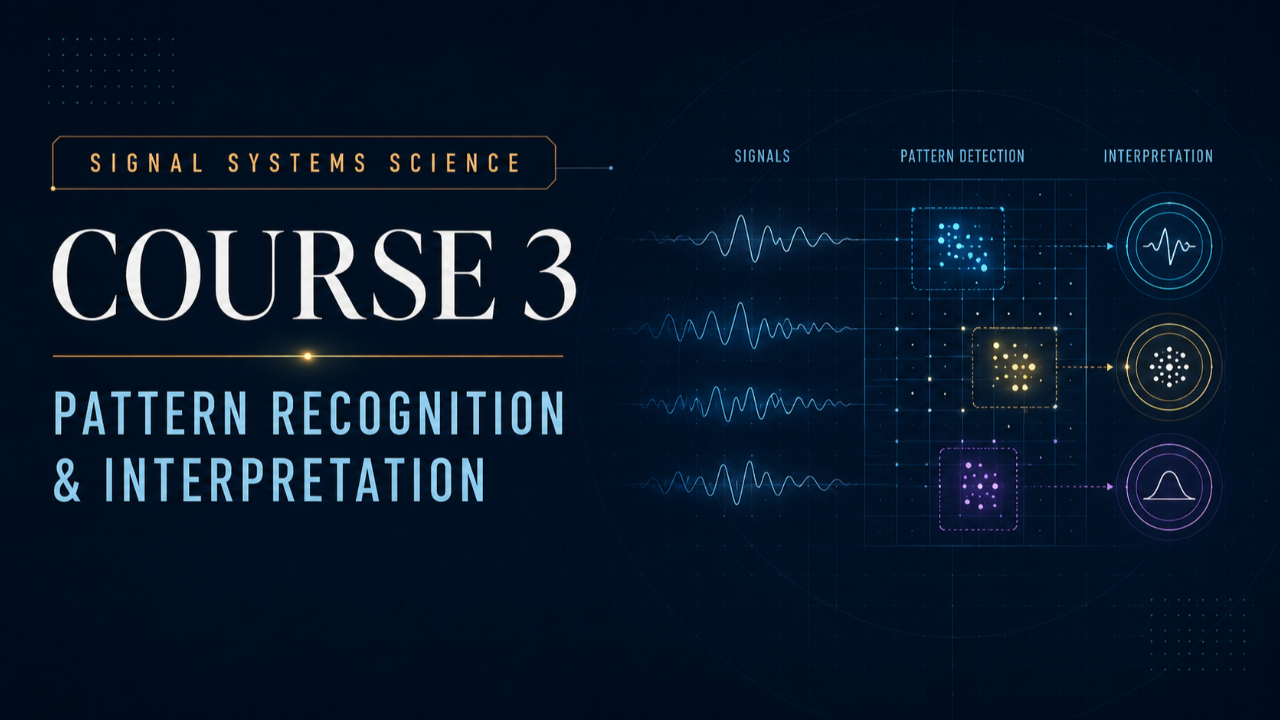
Course 3: Pattern Recognition & Interpretation Systems
Learn How Signals Become Patterns, Meaning, and Decisions
Understand how repeated signals form patterns, how systems filter what they notice, and how interpretation shapes meaning and action.
Course 3 builds on the network-level understanding from Course 2 and introduces the interpretation layer of Signal Systems Science. You will learn how signals become recognizable patterns, how perception filters information, how context shapes interpretation, and how meaning influences decisions.
The core model for this course is:
Signal → Pattern → Perception → Interpretation → Meaning → Decision
What You’ll Receive
Full Course 3 Access
Complete the lessons at your own pace and build a clear understanding of pattern recognition, perception, interpretation, and decision systems.
Course 3 Workbook
Use guided exercises to identify patterns, analyze perception filters, compare interpretations, and map decisions.
Diagram Pack
Review visual models for pattern formation, signal filtering, meaning assignment, and decision pathways.
Module Quizzes
Check your understanding and reinforce the key concepts from each module.
Final Integration Assignment
Apply the full Course 3 framework to one real-world pattern, interpretation, or decision system.
Inside the Course
Module 1 — Pattern Formation and Recognition
Learn how repeated signals create structure, form patterns, and support prediction.
Module 2 — Perception Systems and Signal Filtering
Learn how attention, relevance, thresholds, and bias determine which signals a system notices or ignores.
Module 3 — Interpretation Frameworks and Meaning Assignment
Learn how context, prior knowledge, assumptions, and system rules shape the meaning assigned to patterns.
Module 4 — Signal Meaning and Decision Systems
Learn how interpreted signals move through decision pathways and become actions, responses, and outcomes.
By the End of Course 1
You will be able to:
- recognize how repeated signals form patterns
- distinguish structured patterns from randomness
- identify temporal, spatial, and behavioral patterns
- explain how filtering and attention shape perception
- recognize bias, signal loss, and misinterpretation
- apply interpretation frameworks to real examples
- explain how context changes meaning
- map how interpreted signals become decisions
- use feedback to evaluate decision accuracy
Your Course Access
After completing your purchase, you will receive access to Course 3 — Pattern Recognition & Interpretation Systems, including the course lessons, workbook, diagram pack, module quizzes, and final integration assignment.
Move from signal movement into meaning-making and learn how systems recognize patterns, interpret information, and turn meaning into decisions.
