
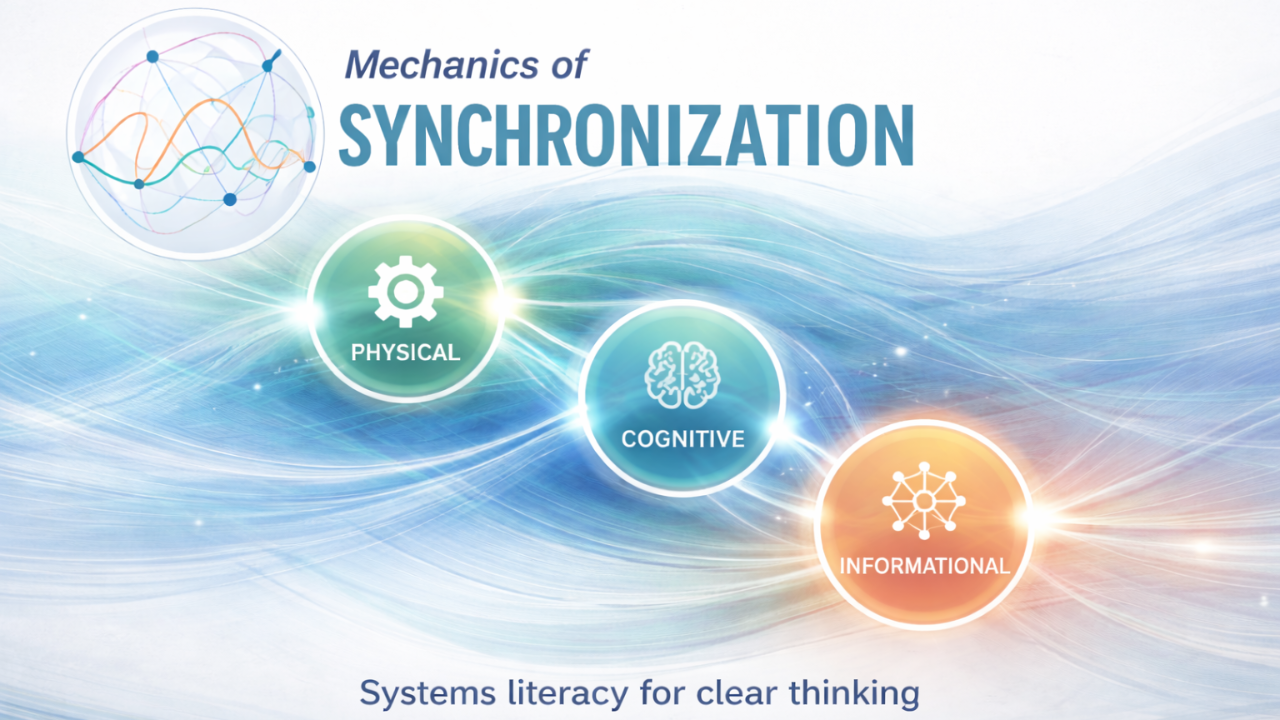
Mechanics of Synchronization
Boundary Conditions Across Physical, Cognitive, and Informational Systems
This course is about disciplined explanation, not belief adoption.
Mechanics of Synchronization is a systems literacy course that teaches how coordination, influence, and belief formation work across different domains, and where explanations break down when boundaries are ignored.
You’ll learn to separate physical mechanisms from biological regulation, cognitive interpretation, and informational influence. The focus is on mechanism over metaphor, timing over drama, and restraint over overreach.
This is not a persuasion course, a therapy program, or an ideological framework. It is training in clarity under complexity.
What you’ll learn:
- How physical synchronization and entrainment actually work, and where they stop
- Why influence is not control, and why timing often matters more than content
- How biological and neural rhythms affect readiness, not belief
- How disruption can create capture windows for narratives
- Why scripts can stabilize systems without guaranteeing truth
- How coordination can emerge through roles and incentives, not conspiracy
- How to identify category errors, premature closure, and over-personalization
- Practical counter-measures: delay, regulation, and functional testing
Course Format:
- A mechanistic understanding of coordination across scales
- 10 structured modules
- Short video lessons
- Practice labs and applied analysis
- Quizzes and a cumulative exam
- Capstone project
- Companion workbook
Each module builds on the last. The course rewards patience, not speed.
Who is this for:
- Graduate students and advanced learners
- Researchers, analysts, and educators
- Professionals navigating complex informational environments
- Anyone who wants to understand influence without fear, mysticism, or exaggeration
Clear thinking is not dramatic.
It is steady, proportional, and disciplined.
Stay in the correct domain. Respect boundary conditions. Delay when necessary.
